Life as a busy woman is a constant balancing act. Between career demands, managing a household, and perhaps raising children, your schedule is packed. Often, the idea of “self-defense” feels like just another chore on a never-ending to-do list: something that requires years of martial arts training or expensive gym memberships.
But here is the reality: effective self-defense isn’t about being a professional fighter. It is about mindset, preparation, and simple habits that make you a “hard target.” Attackers generally look for the path of least resistance. By making yourself even slightly more difficult to target, you significantly increase your safety.
As the Urban Lady Prepper, I believe in practical readiness. You do not need a black belt to stay safe in the city. You need a safety-first mindset and a few reliable strategies that fit into your existing lifestyle.
The Foundation: Safety-First Mindset
The most powerful weapon you possess is not in your purse: it is between your ears. A safety-first mindset means prioritizing your well-being over social niceties. Many women are socialized to be polite, even when they feel uncomfortable. We worry about “seeming rude” or “overreacting.”
Self-defense begins with giving yourself permission to be “rude” if it means staying safe. If someone is making you uncomfortable in an elevator, get out. If a stranger approaches you in a parking lot asking for the time, keep moving. Trusting your intuition: that “gut feeling” is your internal alarm system. Never ignore it.

Master Situational Awareness: The OODA Loop Made Simple
In tactical circles, professionals use a concept called the OODA Loop. It stands for Observe, Orient, Decide, and Act. While it sounds complicated, it is actually a very simple way to process information and stay ahead of potential threats.
- Observe: This is basic situational awareness. Put the phone away. When you are walking from your office to your car or navigating urban transit, your eyes should be up. Look at the people around you. Notice who is lingering and who is moving with purpose.
- Orient: This is where you process what you see. Is that person walking toward you just a fellow commuter, or are they matching your pace and closing the distance? Compare what you see to what is “normal” for that environment.
- Decide: Once you identify something potentially wrong, make a plan. “If that person follows me around this corner, I will cross the street and head toward that well-lit coffee shop.”
- Act: Execute your plan. Do not hesitate. The faster you move from “Observe” to “Act,” the less time a potential attacker has to catch you off guard.
For busy moms, this is even more critical. When you are focused on a toddler or loading groceries, your “Observe” phase can easily slip. Make it a habit to do a “perimeter check” before you even step out of a store or a building.
Navigating Urban Transit and Outings with Kids
Being a single woman or a mom in the city presents unique challenges. When your hands are full of diaper bags or grocery sacks, you may feel vulnerable.
On Public Transit:
- Sit near the driver or the conductor.
- Stay awake and alert; avoid nodding off after a long day.
- If you feel someone is watching you, make brief, confident eye contact. This lets them know you have spotted them and are not an “unaware” target.
- Keep your bags close to your body, ideally across your chest.
When You Are with Kids:
- Teach your children a “safety word” or a specific signal that means “we need to move fast now.”
- If they are old enough to understand, let them know they are part of the family safety team, and that it’s important they pay attention to their surroundings and listen to you without question.
- If you are being followed while pushing a stroller, head toward a crowded area immediately. Your stroller can actually act as a physical barrier between you and someone else if positioned correctly.
- Always have your keys in your hand before you reach your car or front door. Fumbling through a bag while managing kids is a moment of high vulnerability.
Everyday Items as Defense Tools
You do not need specialized tactical gear to defend yourself. Your everyday carry (EDC) is full of potential tools.
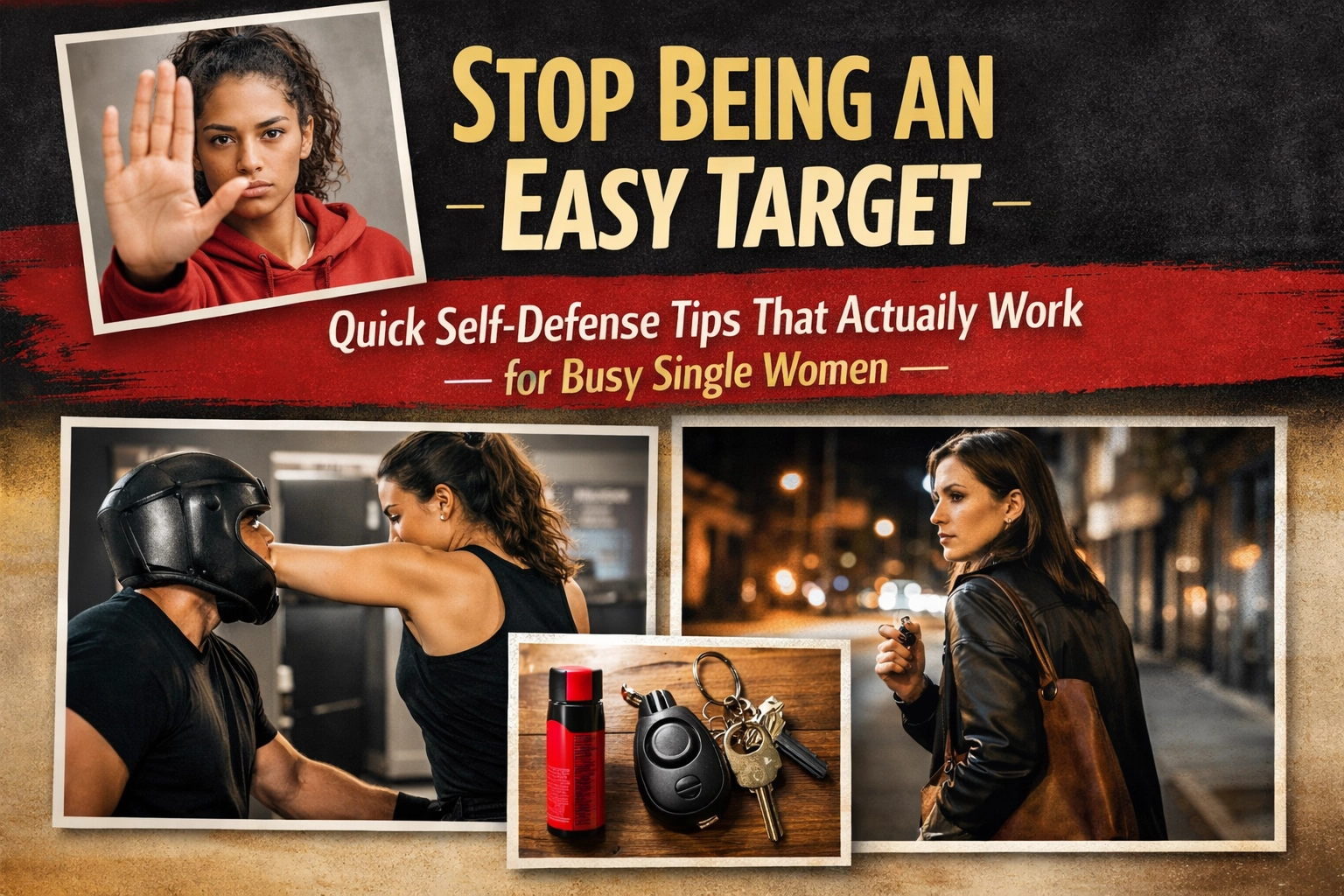
- Keys: Hold your keys in a firm grip. A “hammer strike” with a key protruding from the bottom of your fist can be incredibly effective if you need to create space.
- Flashlight: A small, high-lumens flashlight is one of the best tools for urban safety. It can disorient an attacker in the dark and help you see potential hazards before you reach them.
- Pens: A sturdy metal pen can serve as a makeshift striking tool.
- Your Voice: This is your loudest and most accessible tool. If someone approaches you, a firm, loud “BACK OFF” or “STAY AWAY” can startle them and draw the attention of bystanders.
High-Impact, Low-Skill Physical Moves
If a situation turns physical, your goal is not to win a fight; it is to create an opening so you can escape. Focus on the “soft spots” of an attacker.
- The Palm Strike: Instead of a punch (which can break the small bones in your hand), use the heel of your palm. Aim for the nose or chin. An upward strike to the nose is painful and causes the eyes to water, giving you seconds to run.
- The Groin Kick: This is a classic for a reason. Use your shin or the top of your foot for maximum surface area.
- The Elbow Strike: If someone grabs you from behind or is very close, your elbows are the hardest points on your body. Strike back toward the face or ribs.